

By Eduard Bardají on Oct 9, 2025, 9:10:02 AM

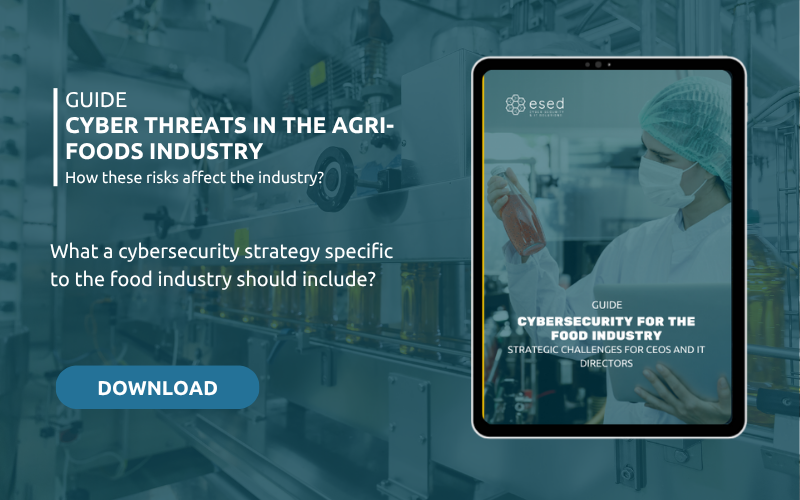
The food industry continues to accelerate its digital transformation. Production plants, traceability systems, logistics, warehouses, cold chains, and other operations increasingly depend on connected systems to maintain efficiency and ensure supply.
This evolution is also changing the risk landscape. A cyberattack can affect IT systems, but also industrial processes, production lines, sensors, control systems, or platforms used by suppliers. In 2027, cybersecurity will need to protect not only information, but also production continuity and the security of the entire food supply chain.
Cybersecurity Trends for the Food Industry
Security by Design and Protection of Connected Systems
Security will need to be incorporated into the design of new plants, applications, sensors, and automation systems. This approach, known as Security by Design, aims to integrate cybersecurity from the beginning rather than adding it later.
In 2027, this approach will need to consider both the security of the device itself and its connections to other systems. Secure configuration, credential management, updates, and supplier assessments will be essential to prevent new technologies from introducing risks to production.
IT/OT Convergence and Network Segmentation
The growing connection between corporate systems and industrial environments means that maintaining separation between IT and OT will remain essential. In 2027, companies will need to strengthen network segmentation, control communications between environments, and limit access to prevent an incident that starts in a corporate system from spreading to systems that control production.
Continuous Monitoring and Incident Response
Security solutions should no longer be limited to generating alerts. The combination of MDR, continuous monitoring and artificial intelligence will make it possible to analyze events from IT systems, networks, and connected devices to detect threats more quickly. Response measures will also need to be adapted to industrial environments, since automatically isolating certain equipment can have consequences for production.
Identity and Access Management for Employees and Suppliers
A production facility may have employees, external technicians, equipment manufacturers, and other suppliers with access to critical systems. In 2027, MFA, least-privilege access, temporary access, and account reviews will be essential measures for controlling who can access each system and reducing the impact of compromised credentials.
Vulnerability and Industrial Asset Management
Industrial equipment and sensors can have long lifecycles and may not always allow updates to be applied immediately. Organizations will therefore need to maintain an up-to-date inventory of assets, identify their vulnerabilities, and prioritize those that could actually affect production, applying additional protection measures when a patch is not feasible.
Cyber Resilience Drills and Continuous Training
The ability to respond to ransomware or an attack targeting industrial infrastructure needs to be tested through practice. Ransomware simulations, security testing, and coordinated exercises between IT, OT, and production teams will help identify weaknesses in procedures, improve response times, and verify that the company can maintain or recover operations following an incident.
Supplier Security and the Digital Supply Chain
Dependence on technology, logistics, and service providers increases an organization's risk exposure. In 2027, third-party security will need to go beyond an initial assessment and include access controls, reviews of their security measures, and clear incident response procedures to prevent a breach at a supplier from affecting production.
Data Protection, Traceability, and Information Integrity
Traceability data, formulas, quality controls, supplier information, and production processes are strategic assets. Protection will need to ensure not only confidentiality, but also data integrity through access controls, encryption, activity logs, and backups that make it possible to detect or recover unauthorized changes.
AI, Cyber Intelligence, and Detection of New Threats
Artificial intelligence will play an increasingly important role in both defense and attacks. Food companies will be able to use AI to analyze events and prioritize risks, but they will also need to control how AI tools and agents are used. Cyber intelligence will help organizations anticipate threats such as ransomware, targeted phishing, and attacks against suppliers and industrial environments.
Digitalization increases efficiency, but it also increases technological dependence. In 2027, cybersecurity will need to be integrated into business continuity by protecting IT and OT environments, controlling access and suppliers, and ensuring recovery after incidents.
At ESED, we help food companies prevent, monitor, and respond to threats through managed cybersecurity services, audits, security testing, and continuous monitoring tailored to their infrastructure and needs.

Cybersecurity Trends for Biotech Companies in 2027

IT Services trends that will shape 2027
.png?width=262&height=150&name=accio-10-negre%20(1).png)

.jpg?width=1150&height=64&name=ADHESIVO%20P%C3%81GINA%20WEB%20(1).jpg)