


By Esteban Sardanyés on Mar 17, 2026, 10:00:00 AM
Artificial intelligence is significantly transforming the way phishing attacks are carried out. What once required time, technical knowledge, and manual writing can now be generated in seconds using advanced language models capable of adapting tone, context, and style to each victim.
This change not only increases the volume of attacks, but also their credibility. AI-generated messages eliminate grammatical errors, mimic internal communication patterns, and use publicly available information extracted from professional networks, social media profiles, or previous data breaches.

How AI Redefines Phishing
Generative models enable large-scale hyper-personalized campaigns. Instead of sending the same message to thousands of users, attackers can generate thousands of different versions tailored to each target’s role, industry, or professional context.
Beyond email, AI facilitates the integration of multiple channels: SMS, instant messaging, and even phone calls with cloned voices. This combination increases psychological pressure on victims and reduces their ability to detect inconsistencies.
The volume of phishing-related attacks has grown by more than 500% in recent years, and success rates in targeted campaigns have increased significantly.
Economic and Operational Impact
The impact of these attacks goes far beyond the theft of a credential. A compromised account can become the starting point for financial fraud, access to cloud environments, lateral movement within the network, or ransomware deployment.
Globally, losses associated with phishing and impersonation fraud reach billions of dollars annually. However, direct financial costs are only part of the problem.
Breaches resulting from phishing affect corporate reputation, undermine trust among customers and employees, and may lead to regulatory non-compliance with significant legal consequences.
Essential Security Measures to Protect Against AI-Generated Phishing
Phishing-Resistant Authentication
Defense should focus on minimizing the impact of compromised credentials. Implementing methods such as FIDO2 or physical security keys significantly reduces the effectiveness of fake portals and identity impersonation, protecting critical access even if a message appears legitimate.
Email Policies and Advanced Monitoring
Technology should be complemented with robust email configurations, early detection of newly registered domains, and XDR platforms capable of correlating signals. This enables the identification of coordinated campaigns and anomalous behavior before a serious incident occurs.
Internal Verification Processes
Establishing clear procedures for payments, vendor changes, or sensitive requests acts as a critical safeguard. These processes must be applied consistently across all channels (email, SMS, or phone calls) to prevent social engineering from bypassing internal controls.
Advanced Training and Realistic Simulations
Workforce preparedness is essential. Training teams to recognize advanced social engineering, internal impersonation, and voice or video deepfakes helps reduce the success rate of AI-powered phishing campaigns and increases organizational resilience.

Want to Learn More?
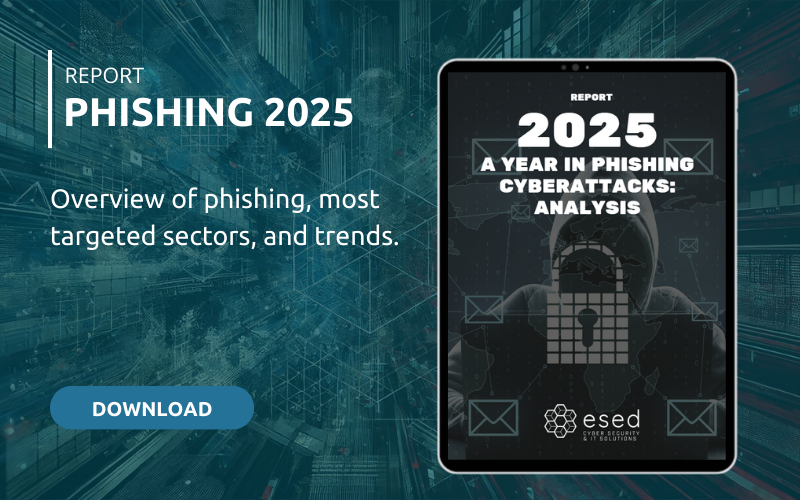
At ESED, we have prepared a detailed report titled: Phishing Cyberattacks Summary 2025. This document provides a comprehensive analysis with figures and specific defense strategies for businesses, covering the state of phishing cyberattacks both globally and in Spain.

Essential cybersecurity measures for hospitals

How to Implement Comprehensive Cybersecurity Plan Logistics Operators

.png?width=262&height=150&name=accio-10-negre%20(1).png)


.jpg?width=1150&height=64&name=ADHESIVO%20P%C3%81GINA%20WEB%20(1).jpg)